How to Get Office Vending Services in 2026
Getting office vending services set up is a lot simpler than most people expect. There's no long sales process and no upfront investment for offices that qualify. It comes down to a few clear steps: confirm eligibility, choose your vending mix, decide what to bundle in, and get installed.
We put together this guide to walk through exactly what that process looks like in 2026, what's free, what's paid, and how the same setup scales from a single office to a national account with locations across the country.
TL;DR: Quick Answers (Office Vending Services)
- Where do I start?
Confirm your office qualifies based on headcount or foot traffic, then choose your vending mix. - What's actually free?
Soda and snack vending, micro markets, and massage chair vending are free-placement services for qualifying offices. - What costs extra?
Office coffee service, pantry delivery, and water and ice service are paid add-ons that bundle into the same contract. - Does this work for multiple locations?
Yes. National accounts use the same process under one contract and one point of contact. - Can I pick Coke or Pepsi?
Yes, your vending mix can be built around either brand family.
Step 1: Confirm Your Office Qualifies
Before anything else, it's worth checking whether your office meets the thresholds for free vending machine placement. A soda machine typically requires 40 or more employees on-site. A combined snack and soda setup usually needs 75 or more. A micro market generally requires around 125 or more people and 150 to 200 square feet of space for the open shelving and self-checkout kiosk.
These numbers exist because vending only makes sense as a free-placement service when there's enough regular traffic to keep the equipment stocked and moving. A machine that sits mostly untouched costs more to service than it generates, which is why the threshold isn't arbitrary. It protects both sides of the arrangement. Shelf life matters here too. Vending products expire, and when sales are too low, items sit past their dates. Expired product frustrates employees and costs the operator money.
If you're not sure where your office lands, it's still worth checking your specific numbers, since eligibility can vary by building traffic patterns and location. Multi-tenant office buildings, for example, sometimes qualify based on combined foot traffic across several companies rather than a single employer's headcount. This is also the point where a knowledgeable vending management company can help you obtain vending market services for offices, since a single point of contact can confirm eligibility and walk you through next steps without a drawn-out back and forth.
Step 2: Choose Your Vending Mix
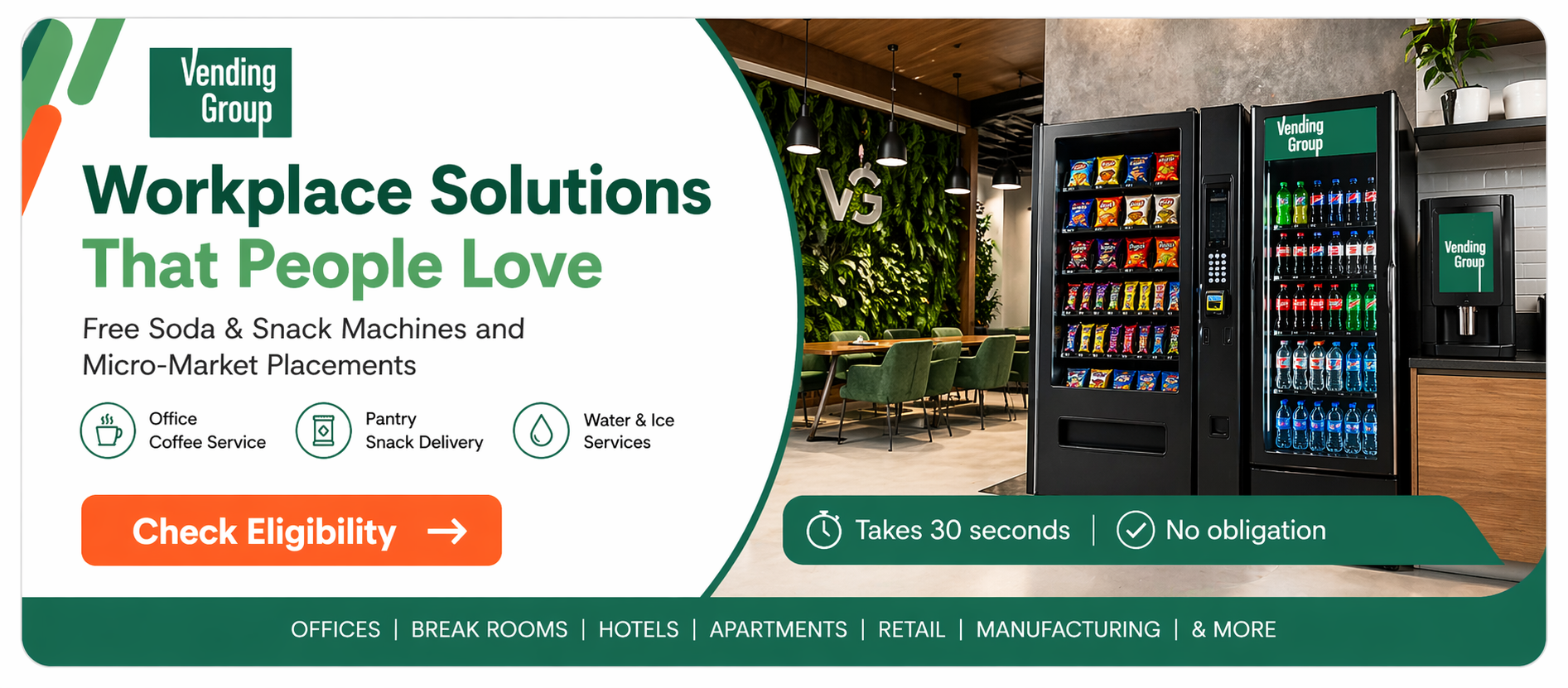
Once eligibility is confirmed, the next step is deciding what goes in your breakroom. Most offices start with our vending machine services, which cover the core equipment, restocking, and repair, then layer in additional options as the space and team size allow.
Beverage brand is usually the first real decision. If your office leans toward classic soda favorites, a Coca-Cola vending machine covers the full range of Coke products, from the flagship cola to flavored and diet options. Some offices prefer the alternative lineup instead, and a Pepsi vending machine gives you access to that full family of products under one machine. Either way, the equipment, installation, and restocking process is identical. The branding decision comes down to what your team will actually reach for.
Step 3: Decide What to Bundle In
Vending rarely stands alone in a well-run breakroom. Most offices we work with pair their free-placement vending with one or more paid add-ons that round out the space.
Office coffee service is the most common pairing, since coffee is one of the few amenities employees notice daily, for better or worse. A well-run office coffee service means fresh equipment, regular supply drop-offs, and one less thing for facilities to manage on top of everything else. Beyond coffee, pantry snack delivery and water and ice service both bundle in under the same account, so you're still working with one contract and one invoice instead of separate vendors for every category.
The point isn't to add every service just because it's available. It's to build a breakroom that actually matches what your team uses, without turning vendor management into a second job for whoever's in charge of facilities.
Step 4: Installation and Ongoing Service
Once your mix is set, installation is handled end to end: delivery, equipment setup, and a restocking schedule built around actual usage rather than a fixed guess. Modern machines track what's selling in real time, so restocking visits are based on demand instead of a generic route schedule that might hit your office too often or not often enough.
If something needs repair down the line, there's one point of contact for the whole relationship rather than separate vendors for equipment, restocking, and maintenance. This is also where the value of a managed service shows up most clearly. A vending machine that sits empty for two weeks because nobody knew who to call is a common complaint with fragmented, multi-vendor setups. A single point of contact removes that problem entirely, since there's no question about who's responsible when something goes wrong.
Payment technology is part of this step too. Most offices in 2026 expect cashless options, tap-to-pay, and mobile wallets alongside traditional cash and card readers, and that's built into the equipment from day one rather than added later as an afterthought.
Getting Office Vending Right at Scale
The steps above work the same whether you're setting up one office or coordinating dozens of locations nationwide. That consistency is exactly why larger organizations rely on this process.
Retail and industrial businesses count on the same model. Companies like DSW and 84 Lumber are part of the client base that relies on this exact setup, coordinated soda and snack vending across multiple sites without needing a different vendor relationship at each one. Whether you're running a single office or a footprint that spans the country, the process, the contract structure, and the point of contact stay the same.
Why This Process Matters More Than People Think
It's easy to treat vending setup as a minor administrative task, but it saves real time. The average U.S. lunch break runs about 36 minutes, but a trip off-site for food routinely eats up 45 to 60 minutes once you factor in travel and wait times. Getting vending set up correctly the first time removes that friction for good, which is worth more over a year than it sounds like on day one.
FAQ: Getting Office Vending Services
How do I get started with office vending services?
Start by confirming your office qualifies based on employee count or foot traffic, then choose your vending mix and any paid add-ons like coffee or pantry delivery.
Is office vending really free?
Soda and snack vending, micro markets, and massage chair vending are free-placement services for offices that meet the qualification thresholds. Coffee, pantry delivery, and water and ice service are paid add-ons.
What if my office is too small to qualify?
Qualification is usually based on employee count, generally 40 or more for a soda machine and 75 or more for combined snack and soda. It's worth checking your specific numbers even if you're close to the threshold. If there is public access as well, you may still qualify.
Can I get both Coke and Pepsi products in my office?
Machines are generally set up around one brand family, either a Coke or Pepsi lineup, though the underlying service, restocking, and repair process is identical either way.
Does this process work for multiple office locations?
Yes. National accounts go through the same core steps, confirming eligibility, choosing a vending mix, and bundling in add-ons, all under one contract and one point of contact across every site.